 Omid Farhang
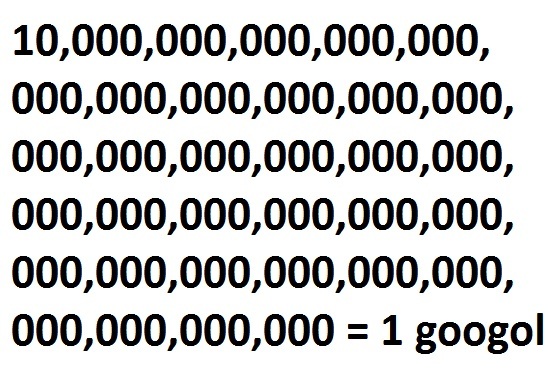
A googol: 1 followed by 100 zeros. Still tiny next to a googolplex.
Tonight I was talking with a friend about bad news for Google when he asked, almost as a side note:
Did you know googol is a number?
I did not. I knew Google, not googol. So I went looking — and fell into the oddly satisfying rabbit hole of named large numbers.
What is the largest number you know by name?
Short scale vs long scale
Before the big names, a quiet trap: the same word can mean different powers of ten depending on where you learned arithmetic.
| Name | Short scale (US, Canada, modern British) | Long scale (continental Europe, older British) |
|---|---|---|
| Million | 106 | 106 |
| Milliard | 109 | — |
| Billion | 109 | 1012 |
| Trillion | 1012 | 1018 |
| Quadrillion | 1015 | 1024 |
| Quintillion | 1018 | 1030 |
| Sextillion | 1021 | 1036 |
| Septillion | 1024 | 1042 |
| Octillion | 1027 | 1048 |
| Nonillion | 1030 | 1054 |
| Decillion | 1033 | 1060 |
| Undecillion | 1036 | 1066 |
| Duodecillion | 1039 | 1072 |
| Tredecillion | 1042 | 1078 |
| Quattuordecillion | 1045 | 1084 |
| Quindecillion | 1048 | 1090 |
| Sexdecillion | 1051 | 1096 |
| Septendecillion | 1054 | 10102 |
| Octodecillion | 1057 | 10108 |
| Novemdecillion | 1060 | 10114 |
| Vigintillion | 1063 | 10120 |
| Centillion | 10303 | 10600 |
On the short scale, each new -illion is a thousand times the previous one (billion = thousand million, trillion = thousand billion, …). On the long scale, each new -illion is a million times the previous one — so a European “billion” is what Americans call a trillion.
That alone explains a surprising number of confused news headlines about government budgets.
Apart from million, these -illion words come from Latin-ish prefixes (bi-, tri-, quadri-, …) stuck onto the stem -illion. Centillion is usually the highest -illion you’ll find in mainstream dictionaries. You can keep inventing names (trigintillion, unvigintillion, …), but that does not make them “official” — they’re pattern extensions, not common vocabulary.
Googol and googolplex
Then there are the celebrity numbers that aren’t -illions at all:
| Name | Value |
|---|---|
| Googol | 10100 |
| Googolplex | 10googol |
A googol is a 1 followed by 100 zeros. Edward Kasner popularized the name in the 1930s (story goes his young nephew Milton Sirotta coined it). A googolplex is a 1 followed by a googol zeros — a number so large that writing it out in ordinary decimal digits is physically impossible in our universe. There aren’t enough atoms for the zeros.
A few reference points, just for scale:
- Atoms in the observable universe: on the order of 1080 — already well below a googol.
- A googol: 10100 — bigger than the atom count, still “writable” if you’re patient.
- A googolplex: 1010100 — you cannot write it down. Not even close.
Dictionaries generally include googol and googolplex (crediting Kasner / Newman / the nephew). They usually stop there — names like googolduplex exist mostly as curious fan extensions. The Oxford English Dictionary notes that googol and googolplex are “not in formal mathematical use.” They’re names for intuition, not tools you write proofs with.
And yes: Google the company is a deliberate misspelling of googol — a joke about indexing a huge amount of information that became the most famous brand on the web. Which is how a math-trivia night ended up tangled with company news in the first place.
Is there a largest number?
No. For any named finite number N, N + 1 is larger. You can always go bigger.
There are named numbers that dwarf googolplex — Graham’s number is a classic example from combinatorial mathematics — but the deeper point is simpler: names run out long before the integers do. Language is a tiny island in an ocean of unnameable sizes.
So maybe the better question isn’t “what’s the largest number you know?” but “how far does your mental map of size go — and where does it stop feeling real?”
Mine used to stop somewhere around “billion.” Tonight it briefly included googolplex. Tomorrow it’ll probably shrink back to whatever fits in a bank statement — and that’s fine. The fun is knowing the cliff is there.
Source for the naming tables: Names of large numbers on Wikipedia.